Last updated: 2026-03-06
Reading duration: 13 minutes
If your dog suffers from itchy skin, chronic dermatitis, or slow-healing wounds, you’re not alone. Skin problems are one of the top reasons pet owners visit the vet—and at REDDOT LED, we hear about these challenges every day. Over the past decade, we’ve worked at the forefront of red light therapy technology, helping veterinary professionals and pet owners discover a safer, non-invasive approach to canine skin care.
Red light therapy—also known as photobiomodulation (PBM) or low-level light therapy (LLLT)—uses specific wavelengths of red and near-infrared (NIR) light to stimulate cellular repair, reduce inflammation, and accelerate healing. In this comprehensive guide, we’ll walk you through everything you need to know: common canine skin conditions, proven benefits, scientific evidence, safe usage protocols, device selection, and what the future holds.
Whether you’re a veterinary professional or a dedicated pet parent, this guide will help you understand why red light therapy for dogs is rapidly becoming an essential part of modern canine skin care—and how REDDOT LED devices are engineered for exactly this purpose.
📋 Article Highlights at a Glance
- Common canine skin diseases — Allergic dermatitis, hot spots, bacterial/fungal infections, autoimmune disorders, parasitic conditions, and chronic wounds are among the most prevalent skin problems in dogs.
- How red light therapy works — Wavelengths of 630–660 nm (red) and 810–850 nm (near-infrared) penetrate skin tissue, boost cellular ATP production, and trigger the body’s natural repair mechanisms.
- Six proven benefits — Accelerated wound healing, reduced inflammation, pain relief, antibacterial effects, enhanced circulation, and minimized scar formation—all without drugs or side effects.
- Growing scientific evidence — Peer-reviewed studies show red light therapy can reduce canine wound healing time by 30–50%; veterinary adoption is accelerating worldwide (Sources: PMC9502196, PMC9951699).
- Safe usage protocols — Optimal treatment parameters include 4–10 J/cm² energy dose, 10–50 mW/cm² power density, and 3–15 minute sessions; always consult your veterinarian first.
- Professional vs. consumer devices — Professional devices deliver higher power and tighter wavelength precision; consumer devices suit at-home maintenance.
- Key safety precautions — Eye protection is mandatory; avoid treating over tumors, active bleeding, or the thyroid; keep a detailed treatment log.
- Device selection guide — Prioritize dual-wavelength capability, verified power output, durable build quality, and third-party testing certification.
- Future trends — Personalized AI-driven dosing, combination therapies (PBM + PRP/stem cells), smart connected devices, and expanding clinical research are shaping the next era of veterinary photobiomodulation.
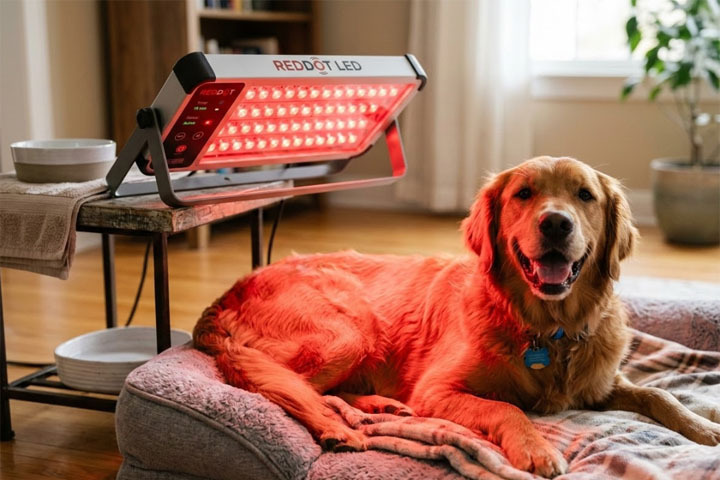
The happy dog is undergoing red light therapy.
Common Skin Diseases in Dogs
Dogs develop a wide range of skin conditions—from allergic dermatitis and hot spots to bacterial infections and autoimmune diseases. Understanding these conditions is the first step toward choosing the right treatment, including red light therapy.
Allergic Dermatitis
Allergic dermatitis is one of the most common canine skin conditions we see. It can be triggered by environmental allergens (pollen, dust mites, mold), food sensitivities, or flea bites. Atopic dermatitis, the hereditary form, affects roughly 10–15% of all dogs. Symptoms include persistent itching, redness, thickened skin, and hair loss—particularly around the face, paws, ears, and belly.
Hot Spots (Acute Moist Dermatitis)
Hot spots are localized areas of inflamed, infected skin that develop rapidly when a dog licks, scratches, or bites an irritated spot. They’re warm, moist, and painful—and they spread fast without treatment. Breeds with thick coats like Golden Retrievers and German Shepherds are especially prone.
Bacterial and Fungal Infections
Bacterial pyoderma (usually caused by Staphylococcus) presents as pustules, crusty lesions, and hair loss. Fungal infections like ringworm cause circular bald patches with scaly borders. Yeast infections (Malassezia) often target skin folds, ears, and paw pads, producing a musty odor and greasy skin.
Autoimmune Skin Diseases
Conditions such as pemphigus and lupus erythematosus occur when the immune system attacks the body’s own skin cells, causing blisters, ulcers, and crusting. These require immunosuppressive therapy—and in our experience, red light therapy can serve as a valuable adjunctive treatment to support healing.